An ordering interface should not assume everyone uses the same input. KaiSign explores three paths into one cart—and keeps the customer in control by requiring review and explicit confirmation.
Team KAIZEN submitted KaiSign to Seeed Studio’s MAKE A SIGN — Interactive Signage Contest 2026. The project was published on 29 August; the award was announced on 9 October 2026. The published category prize is a US$200 Seeed Product Gift Pack, not cash.
My contribution
Trained a BiLSTM sign-language sequence classifier and deployed recognition software on the edge.
The team
Mathew Joseph, Muhammed Shaheem, Alex Thomas
Tools & technologies
BiLSTMMediaPipeRaspberry PiFastAPIJavaScriptSupabaseGemini Live voice path
What I worked on.
Concrete contributions. Shared achievement.
Recognize a bounded vocabulary
Trained a temporal BiLSTM for sign-language sequences in the ordering prototype. The published pipeline normalizes hand landmarks and processes a 60-frame sequence; this is request classification, not unrestricted ASL translation.
Bring recognition to the physical interface
Deployed recognition software on the edge-hosted prototype. The published architecture identifies a Raspberry Pi as the AI host; the compact XIAO controller is not claimed as the model host.
Treat recognition as a proposal
Contributed software connecting recognized requests with ordering. The team architecture guards weak/no-hand predictions and makes customers confirm the cart before persistence, rather than placing orders from uncertain recognition.
Touch / ASL / voiceProposed preferenceCustomer reviewExplicit confirmationSaved order
What the prototype does—and doesn’t prove.
Demonstration scope
The public project article describes the hardware and software prototype. Local sign recognition and a cloud-backed voice path are different dependencies; the full system is not represented as offline.
Boundaries & limitations
No restaurant rollout or completed accessibility study is claimed. Published comparison-model scores are not presented as BiLSTM scores; the test set is small and participated in model selection. Recognition of dietary requests does not establish food-allergy safety.
From the process.
Original project & event images. Select an image to look closer.
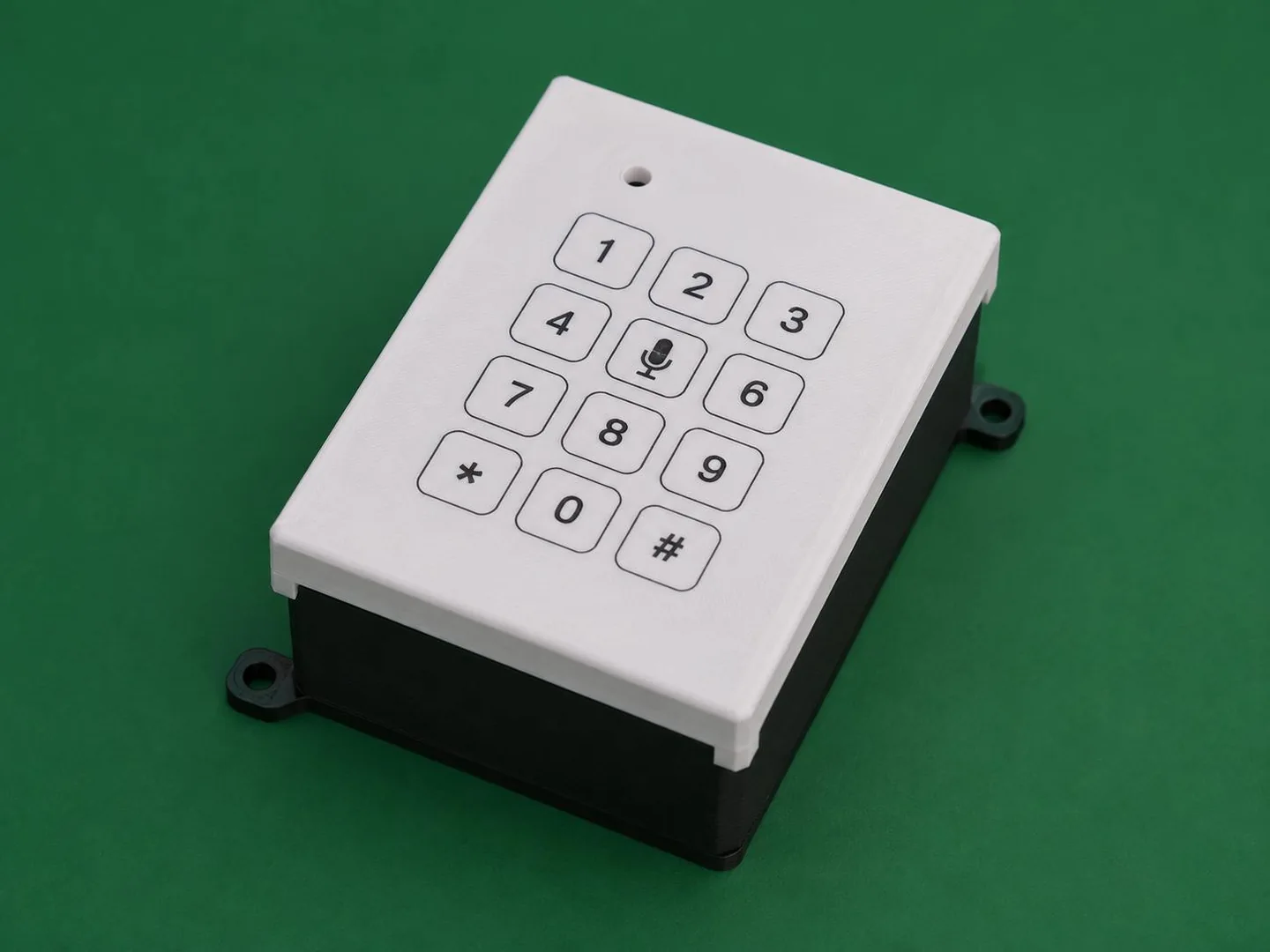
View image The published KaiSign physical input enclosure. Project image from the team’s Hackster article.